1
The meaning of Paul’s discourse in Romans chapter 9
Paul wrote mostly to the Jewish believers in Romans, and it is not until chapter 11, verse 13 that Paul speaks directly to the Gentile believers. That matters in chapter 9 because Paul focuses on a point the Jews could make: that they are the heirs of the promises given to Abraham.
“Who are Israelites; to whom pertaineth the adoption, and the glory, and the covenants, and the giving of the law, and the service of God, and the promises; 5 Whose are the fathers, and of whom as concerning the flesh Christ came, who is over all, God blessed for ever. Amen.”
Romans 9:4–5
Up to this point, Paul has been showing that salvation comes by faith alone, not by the works of the law. The Jews, however, up to this point believed that a Gentile must convert and become a Jew, a follower of the law, to be saved. Now Paul wants to demonstrate that this is not actually true; he does this in verses 6 through 29. Those verses sit between the affirmation that the Jews were given all the things in verses 4 and 5 and the conclusion in verses 30 through 33.
“What shall we say then? That the Gentiles, which followed not after righteousness, have attained to righteousness, even the righteousness which is of faith. 31 But Israel, which followed after the law of righteousness, hath not attained to the law of righteousness. 32 Wherefore? Because they sought it not by faith, but as it were by the works of the law. For they stumbled at that stumblingstone; 33 As it is written, Behold, I lay in Sion a stumblingstone and rock of offence: and whosoever believeth on him shall not be ashamed.”
Romans 9:30–33
It is within this context that we must understand what Paul is trying to say. To make it clear, the context in my mind is the Jews claiming that it is through becoming a Jew that men are made right with God, and Paul claiming that this is not the case, but rather it is through faith alone that makes one a child of God. One could argue that God never changes. He has made promises to the Jews, the children of Abraham, and will not break His promise. Those parenthetical verses between verses 5 and 30 are Paul’s argument against that understanding.
The argument from Ishmael
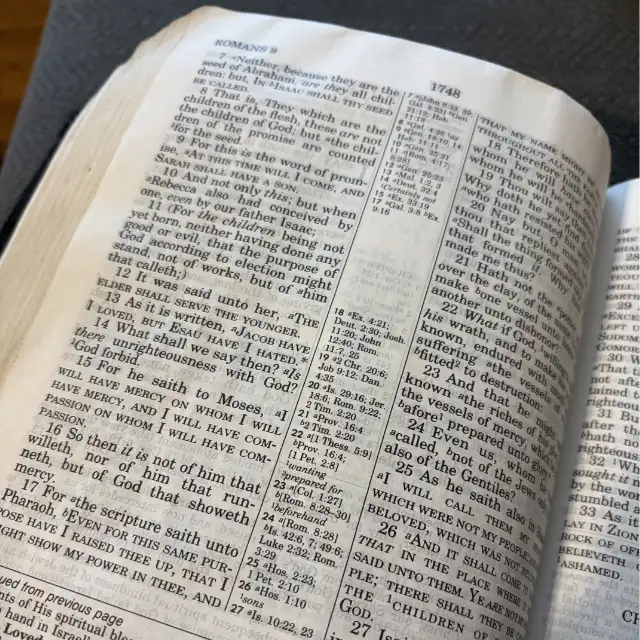
“Not as though the word of God hath taken none effect. For they are not all Israel, which are of Israel: 7 Neither, because they are the seed of Abraham, are they all children: but, In Isaac shall thy seed be called. 8 That is, They which are the children of the flesh, these are not the children of God: but the children of the promise are counted for the seed. 9 For this is the word of promise, At this time will I come, and Sara shall have a son.”
Romans 9:6–9
Paul seems to be saying that you cannot claim that just because you have Abraham’s seed in you, you are automatically children of the promise. The promise was not that all of Abraham’s offspring would be saved or even that Sarah’s offspring would be saved. The promise is that they will be part of a great nation.
“And I will make of thee a great nation, and I will bless thee, and make thy name great; and thou shalt be a blessing: 3 And I will bless them that bless thee, and curse him that curseth thee: and in thee shall all families of the earth be blessed.” Genesis 12:2–3
What seems clear, therefore, is that Edom could not claim they are children of the promise simply because they have Abraham’s seed in them. God can and did limit that promise to the child who would come through Sarah and Abraham. Note this is not about salvation. It did not mean that no descendants of Ishmael could ever be saved.
The argument from Isaac
“And not only this; but when Rebecca also had conceived by one, even by our father Isaac; 11 (For the children being not yet born, neither having done any good or evil, that the purpose of God according to election might stand, not of works, but of him that calleth;) 12 It was said unto her, The elder shall serve the younger. 13 As it is written, Jacob have I loved, but Esau have I hated.”
Romans 9:10–13
Again, this is not an argument that only those who are the seed of Jacob can be saved. We see in Genesis that Essaus is blessed and makes things right with his brother (Genesis 33:4,9; Genesis 36:7). The point here is the tradition that, because the firstborn was to receive a double portion, he would rule over the younger sons.
“But he shall acknowledge the son of the hated for the firstborn, by giving him a double portion of all that he hath: for he is the beginning of his strength; the right of the firstborn is his.”
Deuteronomy 21:17
So Paul uses this illustration to show the Jews that, just because you are the elder, the firstborn, God can’t choose to do something different, such as pass the blessing on to another. God chose the younger in this case, and therefore God can move from the Jews to the Gentiles.
The argument from God’s authority
“What shall we say then? Is there unrighteousness with God? God forbid. 15 For he saith to Moses, I will have mercy on whom I will have mercy, and I will have compassion on whom I will have compassion. 16 So then it is not of him that willeth, nor of him that runneth, but of God that sheweth mercy. 17 For the scripture saith unto Pharaoh, Even for this same purpose have I raised thee up, that I might shew my power in thee, and that my name might be declared throughout all the earth.”
Romans 9:14–17
Paul states that God has the power and authority to accomplish His will and to use whoever He wants. Note that God chose a certain man to be Pharaoh because He knew that this man would not bow to Him as Lord. That man served God’s purpose in completing His plan. I would like to parallel this to God choosing Saul to be king. Because God is all-knowing, He must have known what kind of man Saul was and how he would handle being king. So why did God choose Saul? Was it so that the Lord could destroy him? That does not seem to be the reason. The reason was to teach us a lesson. The Lord wants us to see that we cannot judge people by their appearance. Saul was chosen on those grounds.
“And he had a son, whose name was Saul, a choice young man, and a goodly: and there was not among the children of Israel a goodlier person than he: from his shoulders and upward he was higher than any of the people.”
1 Samuel 9:2
We learn a lesson here: Saul shows he is not worthy to be king, and God shows that He alone knows who is best.
“But the Lord said unto Samuel, Look not on his countenance, or on the height of his stature; because I have refused him: for the Lord seeth not as man seeth; for man looketh on the outward appearance, but the Lord looketh on the heart.”
1 Samuel 16:7
So the lesson of Pharaoh and Saul is that God is not bound by what appears correct; God can and does do what brings about His will. That is not a discussion about who is and is not saved; it is about how God can use us humans and the choices He knows we will make for His glory.
The argument for God’s sovereignty
“Therefore hath he mercy on whom he will have mercy, and whom he will he hardeneth. 19 Thou wilt say then unto me, Why doth he yet find fault? For who hath resisted his will? 20 Nay but, O man, who art thou that repliest against God? Shall the thing formed say to him that formed it, Why hast thou made me thus? 21 Hath not the potter power over the clay, of the same lump to make one vessel unto honor, and another unto dishonour? 22 What if God, willing to shew his wrath, and to make his power known, endured with much longsuffering the vessels of wrath fitted to destruction: 23 And that he might make known the riches of his glory on the vessels of mercy, which he had afore prepared unto glory, 24 Even us, whom he hath called, not of the Jews only, but also of the Gentiles?”
Romans 9:18–24
I am making a distinction between the Lord’s authority and His sovereignty in this way. A company owner has the authority to hire and fire whoever he wants, but he also has the sovereignty to use that employee as he sees fit. In other words, an owner can choose the man for the job and then use that man’s abilities in ways that make his company successful.
With all the words of the Bible that call men to make choices, it seems unreconcilable to assume that these vessels have no choice in what they are. Some are called so God can show His mercy, but this passage does not explain why they are called. If God chooses everyone, then an honest question the Jew would have is why aren’t they chosen? After all, they are children of the promise. One passage that resonates with me is when Jesus looks at Jerusalem and says this.
“O Jerusalem, Jerusalem, thou that killest the prophets, and stonest them which are sent unto thee, how often would I have gathered thy children together, even as a hen gathereth her chickens under her wings, and ye would not!”
Matthew 23:37
If God chooses some for salvation and not others, these words make Jesus seem like a psychopath. I mean, Jesus is saying He would have spared Jerusalem if the people had turned to Him, but He gave them no choice in the matter.
There is a long discussion about how man comes to salvation, but these verses are not the place to solve that. Paul uses these verses to show that God, in His sovereignty, can use good vessels and destroy the bad ones. He is not obligated, as some think, to keep all men alive and bless them.
Paul shows the Lord’s plan.
“As he saith also in Osee, I will call them my people, which were not my people; and her beloved, which was not beloved. 26 And it shall come to pass, that in the place where it was said unto them, Ye are not my people; there shall they be called the children of the living God. 27 Esaias also crieth concerning Israel, Though the number of the children of Israel be as the sand of the sea, a remnant shall be saved: 28 For he will finish the work, and cut it short in righteousness: because a short work will the Lord make upon the earth. 29 And as Esaias said before, Except the Lord of Sabaoth had left us a seed, we had been as Sodoma, and been made like unto Gomorrha.”
Romans 9:25–29
The idea that God will turn His sole attention from the Jew to also include the Gentiles is not something Paul came up with. It is recorded in their book. The Lord will not always focus on the Jews only, as some will be destroyed as they prove themselves to be vessels of dishonor, and then He will graft in other people so that He will have people for His kingdom.
Paul’s conclusion
“What shall we say then? That the Gentiles, which followed not after righteousness, have attained to righteousness, even the righteousness which is of faith. 31 But Israel, which followed after the law of righteousness, hath not attained to the law of righteousness. 32 Wherefore? Because they sought it not by faith, but as it were by the works of the law. For they stumbled at that stumblingstone; 33 As it is written, Behold, I lay in Sion a stumblingstone and rock of offence: and whosoever believeth on him shall not be ashamed.”
Romans 9:30–33
These words clearly show Paul’s intentions. They are not meant to tell us who is and is not saved. It is not about God choosing individuals for salvation. Instead, it is about God’s master plan and His right to carry it out as He sees fit. Paul is showing the Jewish believers what God is doing in the world, and it is not all about being a Jew. Being a physical child of Abraham does not guarantee anyone a place in the Lord’s Kingdom; the Lord is not unjust in doing this, nor does He lack the authority to do it.
Paul then tells us who is saved, as follows.
“That if thou shalt confess with thy mouth the Lord Jesus, and shalt believe in thine heart that God hath raised him from the dead, thou shalt be saved. 10 For with the heart man believeth unto righteousness; and with the mouth confession is made unto salvation. 11 For the scripture saith, Whosoever believeth on him shall not be ashamed. 12 For there is no difference between the Jew and the Greek: for the same Lord over all is rich unto all that call upon him. 13 For whosoever shall call upon the name of the Lord shall be saved.”
Romans 10:9–13

Life is won or lost in the mind!
ThinkFaith is my new YouTube channel where I discuss what I have learned. I have tough questions like everyone else, and I want honest answers. My channel is a place where people can come, hear what I have learned, share their ideas, and ask questions in the comments.